Yes, But I Said It First Through No Fault Of My Own
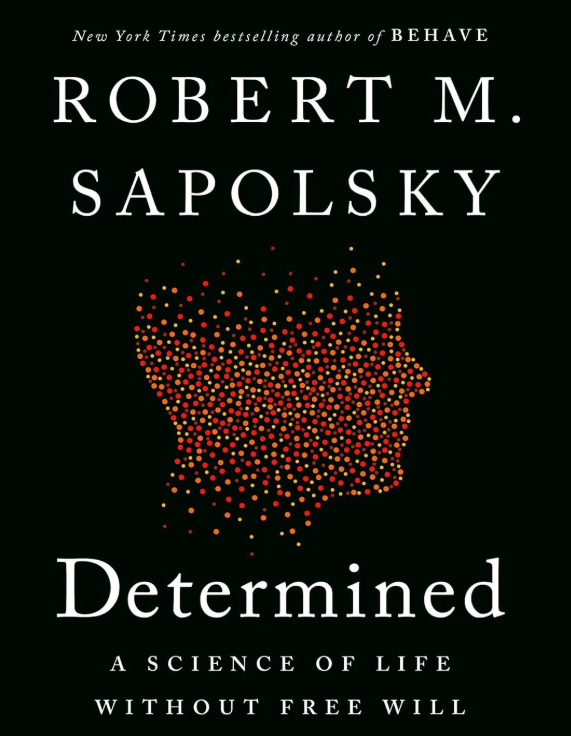
I just finished the audiobook of Determined by Robert Sapolsky. I chose this book mostly out of curiosity. I expect most readers approach this book with a lot of skepticism. They need the author to convince them that free will is an illusion. Myself, I reached the conclusion independently some years back. I wrote about it in my blog at the time: No Heaven (Except What We Make), from April 2019.
The short version of that post is: I became convinced that when people believe in the non-physical, stuff like angels and ghosts and an all-powerful God and an immortal soul, it's much more likely this has happened because people are too quick to form beliefs and too slow to be disabused of the ideas. The best explanations for why things happen, the explanations that hold up over time, are the ones entirely consistent with a purely physical universe -- so that's probably what we have, a universe with no ethereal or spiritual component. In a word: physicalism. "No soul" implies "no free will", just a continuation of this line of thought. Since the human body, brain included, is 100% made of physical stuff, everything it does is necessarily a consequence of what came before. (Sapolsky breaks this down into "a few seconds before", "a few minutes before", "years before" and so on. Same idea, more depth and detail and a lot more neuroscience.) There is no room in the picture for "free will" because it's all just mechanical, a series of particles interacting, stretching back to the Universe's origin.
Sapolsky published his book in 2023. I published my blog post in 2019. I win... I guess. Not that I can take credit for having the idea, any more than Sapolsky can take credit for writing his book. If I'm crowing about having said it first, it's only because I can't help myself.
Besides the neuroscience, which is fascinating on its own, I got some new ideas from his book that I hadn't really fleshed out at the time, though I did mention a couple of them in later posts. For example, there's the distinction he draws between humans' decisions being determined (no free will) and those same decisions being predictable. Even if there were no fundamentally-unpredictable interactions such as those quantum mechanics has saddled us with, there are the bizarre behaviors of entirely deterministic cellular automata, like "Rule 110". I mused about that one in The Answer To The Ultimate Question Of Life, The Universe, And Everything in June 2021. Sapolsky says people assume that if a person's decisions were entirely deterministic, it ought to be possible to predict what they're going to do. We live in a universe that contradicts this intuition. Even an entirely deterministic series of calculations with no randomness whatsoever (quantum or otherwise) can lead to unpredictable future states. Our inability to predict human decision-making, like our inability to predict the weather, does not let us conclude that free will is real.
He reached some of the same conclusions I did in my "No Heaven" post, about the impact on morality. If someone has committed a murder, even a series of them, such decisions can be boiled down to the same ultimate causes as all other decisions: environmental factors (what happened to the person beforehand, all the way back to their gestation and birth), genetic factors (the DNA bequeathed to them by their parents), and randomness. None of it can be "blamed" on the person because none of his decisions, none of anyone's decisions, are truly freely made. As I noted in my blog:
This, in turn, calls into question the very concept of "justice", the idea that it's right to punish someone for how they've acted. That too is based on the idea that the person freely chose to misbehave. It would be better to view the person as a malfunctioning machine (for the body and its brain are just imperfect physical machines), and attempt to find and correct the damage that led to the undesirable behavior. Maybe that damage is internal, maybe it’s environmental. One cause we can rule out is a defect of the soul.
Sapolsky writes a lot about justice, noting that we primates have evolved the capacity to detect cheating amongst our tribe-mates. We need to catch cheaters because freeloaders, running unchecked, will sink a society. Evolution has supplied us with an internal motivation to do this, even when that policing costs us personally. We have a propensity, nay, we take pleasure, in catching cheaters and other misbehaving members of society, and then punishing them for it. Half the time, when we say "justice", we really mean "meting out punishment to offenders". Sapolsky's suggestion is to replace the free-will-based concept of justice with a disease model, one of quarantine, of keeping anyone likely to cause future harm sequestered from anyone they might harm. This doesn't require taking away all the comforts of living. If they can safely cook themselves food, play video games, even afford to attend online college classes, they should have the opportunity to do all of that. Their motions and actions should be constrained just barely enough to prevent them from causing harm, until such time as a cure for their destructive impulses can be found. If they can be rehabilitated, that's the best possible outcome. If not, they should be comfortable in their confinement.
Most would call this response to criminality unacceptable, because justice hasn't been served. The harm caused by an individual must be met with an appropriate amount of harm to them in turn. Anything less is immoral, and denies the victims closure.
Sapolsky counters that this isn't really a moral stance at all, as it is based on emotion, on how good it feels to punish offenders. He further states that seeking closure hasn't been shown to be healing to the victims. In some cases it just re-traumatizes them by forcing to relive the experience. Some victims of crimes, for which the criminal received a death penalty sentence, have sought to have that penalty lifted.
Punishing the deserving, that sense of self-righteous rage and the satisfaction of handing out "just desserts", feels good, just as taking cocaine feels good. That which feels good is not always good for us. Sapolsky is asking us to consider letting it go. Stop looking backward, sizing punishments based on how much harm has been caused. Look only forward, restraining the damaged people so they can't damage others.
The flip side also applies. If you're successful, it's a bit tricky to take credit. Quoting myself again:
I’ve accepted that my success, my nice house and comfortable paycheck, are due in large part to circumstances beyond my control, the vagaries of chance. I’ve made choices in my life, sure, but I didn’t choose my starting point: who my parents were, where I was born, my skin color. Admitting that those things helped does not erase my accomplishments, but it does mean I’d best retain a bit of modesty and humility about them. Otherwise I’d be a huge jerk. Those rich white guys who claim they did it all themselves, pulled themselves up by their bootstraps with no help from anybody? Huge jerks.
Sapolsky has a lot to say to those suffering from a disability or from any condition society chooses to denigrate: being overweight, being gay, having the wrong shade of skin, having a mental handicap (dyslexia, ADHD, autism spectrum, schizophrenia), even being too short. To those people, he says: Take comfort in the fact that this was never your fault. We are all dealt a hand of cards, and you were dealt a lousy hand.
All of this, I agree with.
I'm still left with a nagging issue, one I was hoping Sapolsky would address before the end. If free will is nowhere to be found, and there is no God to whom we could appeal, where then should we turn in search of meaning? Of hope? Accepting determinism may purge us of self-blame, but it isn't great for one's motivation.
Sapolsky mentions that some sufferers of depression may not harbor a skewed view of reality. Quite the opposite. They may be the "sadder but wiser" crowd, the ones who aren't fooling themselves into thinking they can, through a sheer effort of will, break free of their circumstances. This makes me think Sapolsky hasn't figured out a satisfying answer to this conundrum either. For my part, as I proposed in "The Answer To The Ultimate Question", my own best answer remains the Absurdism of Camus. One should, in effect, step outside under the starry night, turn to face the Infinity above, shake your fist at it and yell:
"SCREW YOU, UNIVERSE! I'LL LIFE MY LIFE HOW I WANT AND MAKE MY OWN GODDAMN MEANING!"


Comments
Post a Comment